Key Concepts
This page defines the vocabulary used throughout the IDV Platform documentation. The terms fall into two groups: the people involved in a verification, and the records the platform keeps about them.
People and organizations
| Term | Definition |
|---|---|
| User | A person going through a verification flow — person who is not yet (or not necessarily) a Customer. |
| Customer | A verified person in the Company's database. A User becomes a Customer when a verification succeeds. |
| Tenant | A Company having an account in the Innovatrics' hosted IDV Platform and its isolated space — its own configuration, data, users, and watchlists. One Company is one tenant. |
Records
| Term | Definition |
|---|---|
| Digital Identity | The record of a single verification attempt — the captured images, extracted document data, biometric scores, checks, and the outcome. |
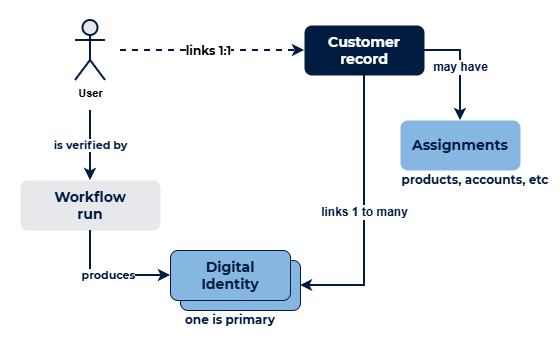
| Customer record | The master record for a person. It holds their current personal data and links to every Digital Identity captured for them over time. |
| Assignment | An optional link between a Customer and something they were sold or issued (a SIM, device, account, policy, ticket). This can ast as an CRM replacement or as an object to link products in external CRM. |
| Trust Factor | A single configurable check — a biometric score threshold, a document validity result, a liveness outcome, an age check. Trust Factors combine into the accept / review / reject decision. |
| Workflow | The ordered sequence of capture steps and checks with result actions that a verification runs through. The workflow is chosen when a session starts. |
| Watchlist | A set of Customer records used for 1:N biometric or document search — the Customer watchlist (existing customers) and the Blocklist (people to reject). |
How the records relate
One physical person has one Customer record per tenant. Each time that person is verified — the initial onboarding, a later data update, an authentication — a new Digital Identity is produced and linked to the Customer record. One of the Digital Identities linked is marked as the Customer's primary identity (the current source of truth for their personal data).
The verification outcome
Every workflow ends in one outcome, recorded on the Digital Identity.
A result on the Trust Factors point of view:
- Accept — the identity is trusted.
- Review — the result is ambiguous and needs a human decision in the back office.
- Reject — the identity was not proven.
- Incomplete — the User did not finish, or capture never reached a usable state.
A result on the Duplicity check point of view:
- Unique - has no other Customer record matching
- Has hits - there are Customer records matching this Digital identity and a human decision is needed to resolve it
- Merged / Updated — the identity matched an existing Customer and was linked to them (see Digital Identity Lifecycle).
See also
- Digital Identity Lifecycle — states, transitions, and the Customer relationship
- How It Works — the end-to-end verification pipeline
- Deployment Models & Data Tiers — what is stored, and when