Criminal records (Applicants)
In Innovatrics ABIS, every person that the system knows about is represented by an entity called an Applicant. In the Criminal Investigation context the same data structure is used to represent a criminal record – a record of a known suspect, a person in custody, a person with prior convictions, a wanted person, or any other person of interest to the agency.
The applicant entity is the same one used by the civil side of ABIS, which means that biometric identification is fully consistent across both contexts. The forensic deployment, however, focuses only on the parts of the model that are relevant to investigative work.
What is an applicant
An applicant is a basic data entity that represents one biometric enrolment of a person. In the criminal context it typically contains:
- a biographic profile (name, aliases, date of birth, nationality, scars / marks / tattoos, gang or organisation affiliation, etc.) – the exact list is configurable per deployment,
- a biometric package (fingerprints, palm prints, facial photograph(s), iris images, optionally a DNA profile),
- a set of binary attachments (booking sheets, court documents, prior arrest reports),
- lifecycle metadata (creation date, current status, ID of the operator who enrolled the applicant, etc.).
One applicant represents one enrolment of a person. When the same person is enrolled more than once (for example after multiple arrests) every enrolment becomes a separate applicant; all of them are then envelope-grouped under one Biometric Individual so that the agency always sees a single, consolidated record of the person.
Applicant data structure
An applicant entity consists of three main data groups:
- Demographic / biographic data – fully configurable textual and binary fields. The set of available fields is defined in the customization phase of the project.
- Biometric data – images and biometric templates of the supported modalities (fingerprints, palms, faces, irises, DNA).
- Metadata – lifecycle information such as creation timestamp, current status, biometric individual ID, etc.
Biometric data
Biometric data is stored according to the deployed licence:
- Store only – binary samples are stored and presented but no templates are extracted. No biometric matching is possible.
- 1:1 matching – templates are extracted and used in 1:1 verification scenarios.
- 1:N matching – templates are extracted and loaded into the Matcher so that 1:N identification can be performed.
For every modality except face the position must be specified. The supported fingerprint positions are:
UnknownFinger, RightThumb, RightIndex, RightMiddle, RightRing, RightLittle, LeftThumb, LeftIndex, LeftMiddle, LeftRing, LeftLittle, PlainRightThumb, PlainLeftThumb, PlainRightFourFingers, PlainLeftFourFingers, PlainThumbsTogether, UnknownPalm, RightFullPalm, RightWritersPalm, LeftFullPalm, LeftWritersPalm, RightLowerPalm, RightUpperPalm, LeftLowerPalm, LeftUpperPalm, RightOther, LeftOther, RightInterdigital, RightThenar, RightHypothenar, LeftInterdigital, LeftThenar, LeftHypothenar, LatentPrint.
The supported impression types are:
PlainContact, RolledContact, LatentImage, LiveSwipe, PlainContactlessStationary, RolledContactlessStationary, Other, Unknown, RolledContactlessMoving, PlainContactlessMoving.
Iris positions are Left, Right or UnknownIris. Faces have only one implicit position.
Metadata
The most relevant metadata fields for criminal records are:
- External ID – unique textual identifier of the record assigned by the agency.
- Applicant status – the current state in the applicant lifecycle (see below).
- Individual ID – the identifier of the enclosing Biometric Individual.
- Individual status – status of the biometric individual.
- Timestamps –
createdAt,updatedAt,enrolledAt.
Applicant lifecycle
A criminal record traverses several lifecycle states. The states are grouped into phases:
Enrolment phase
The record is being constructed and is on its way to the matching engine.
- Draft – record exists in ABIS but no templates have been extracted yet. Cannot be identified or verified. Not counted in the licence applicant count.
- Ready – templates are extracted but not active. Cannot be identified or verified yet.
- Under review – record failed validation and was sent for human inspection.
- Enrolled – first state where the record participates in identification and verification.
Evaluation phase
Records that came out of a non-happy path of deduplication or biometric update (renewal).
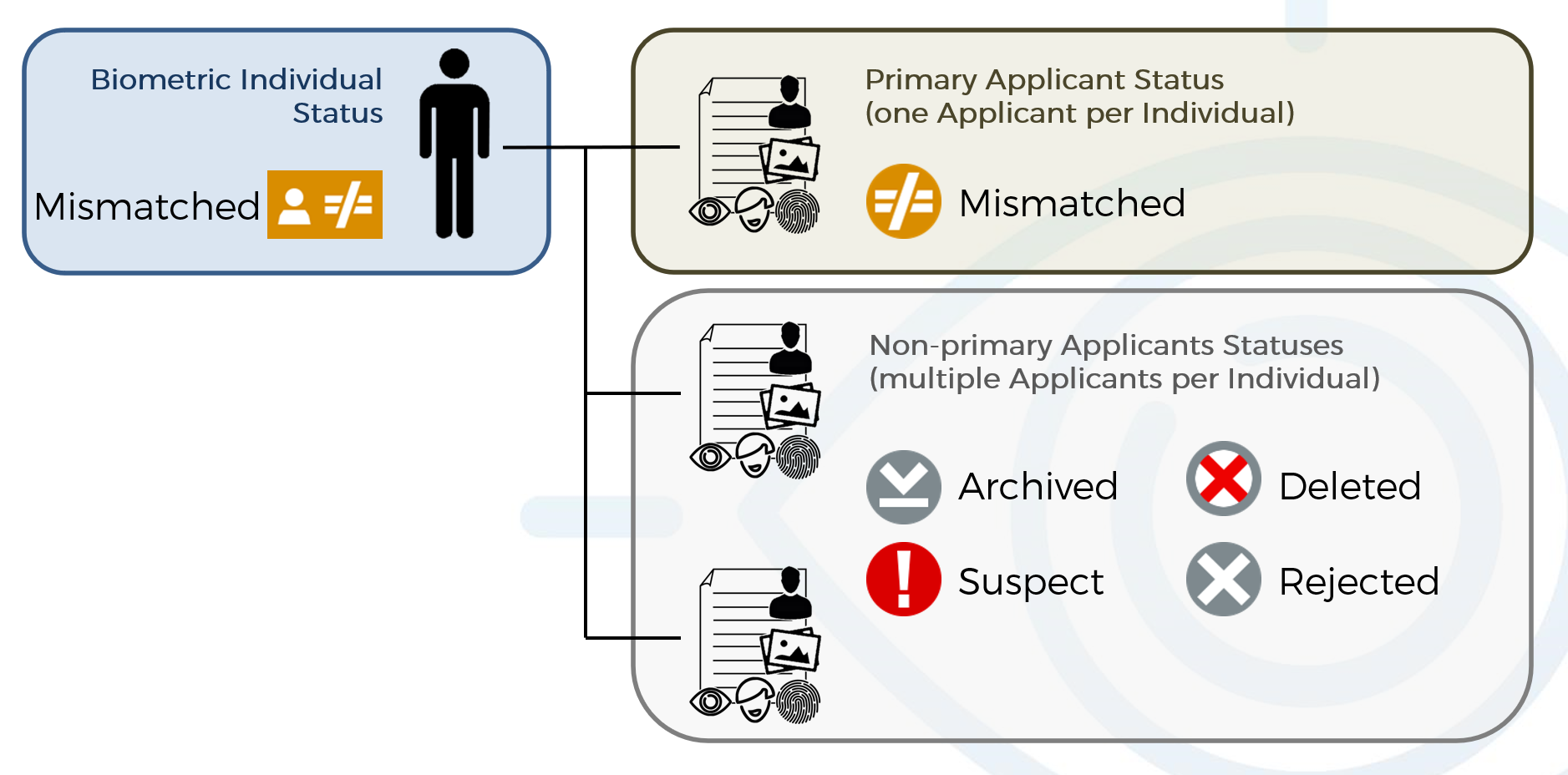
- Mismatched – the record tried to update another record but the modalities did not match.
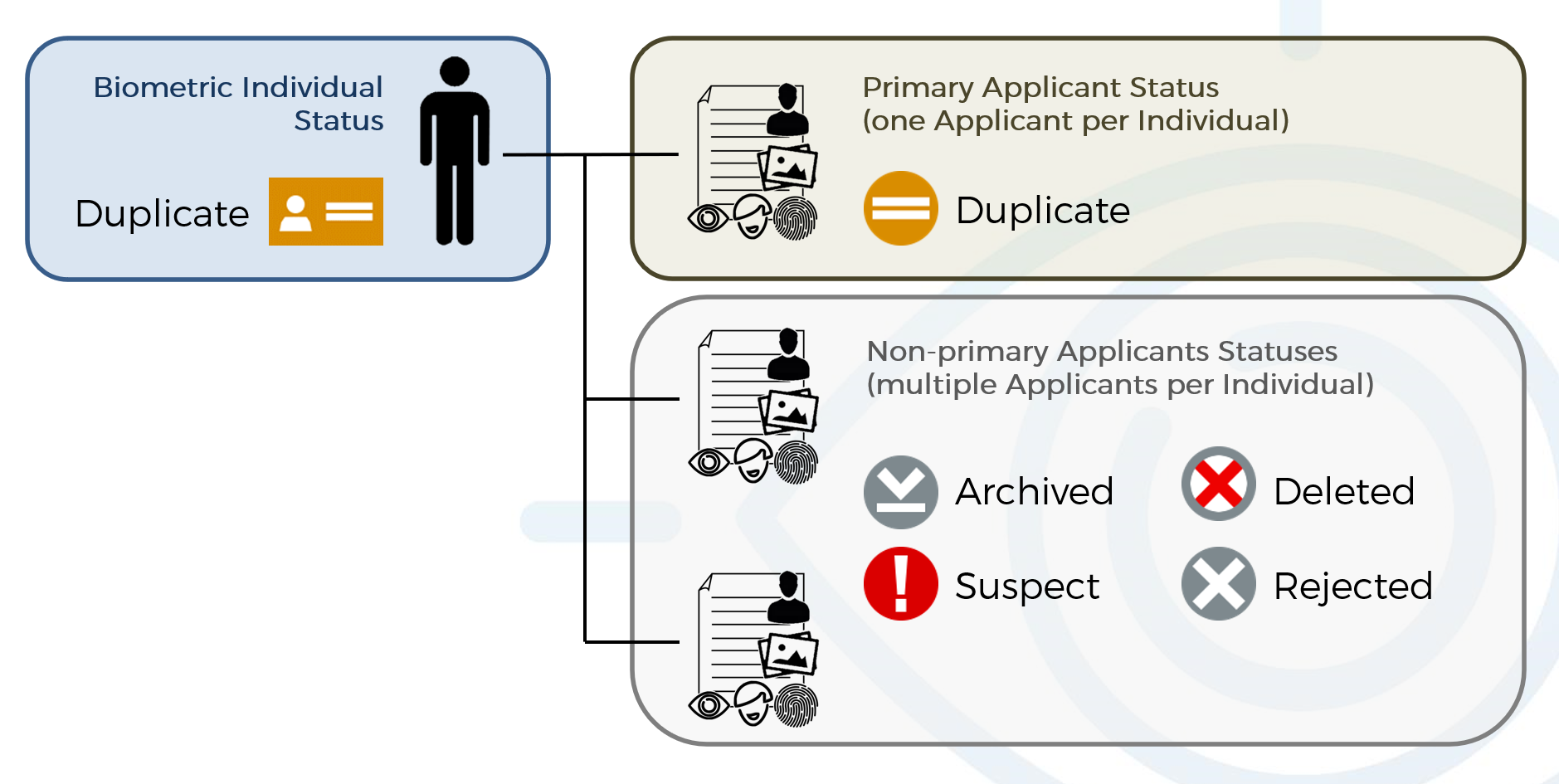
- Duplicate – the record was identified as a duplicate during deduplication.
ABIS phase
Main phase – most criminal records reside here.
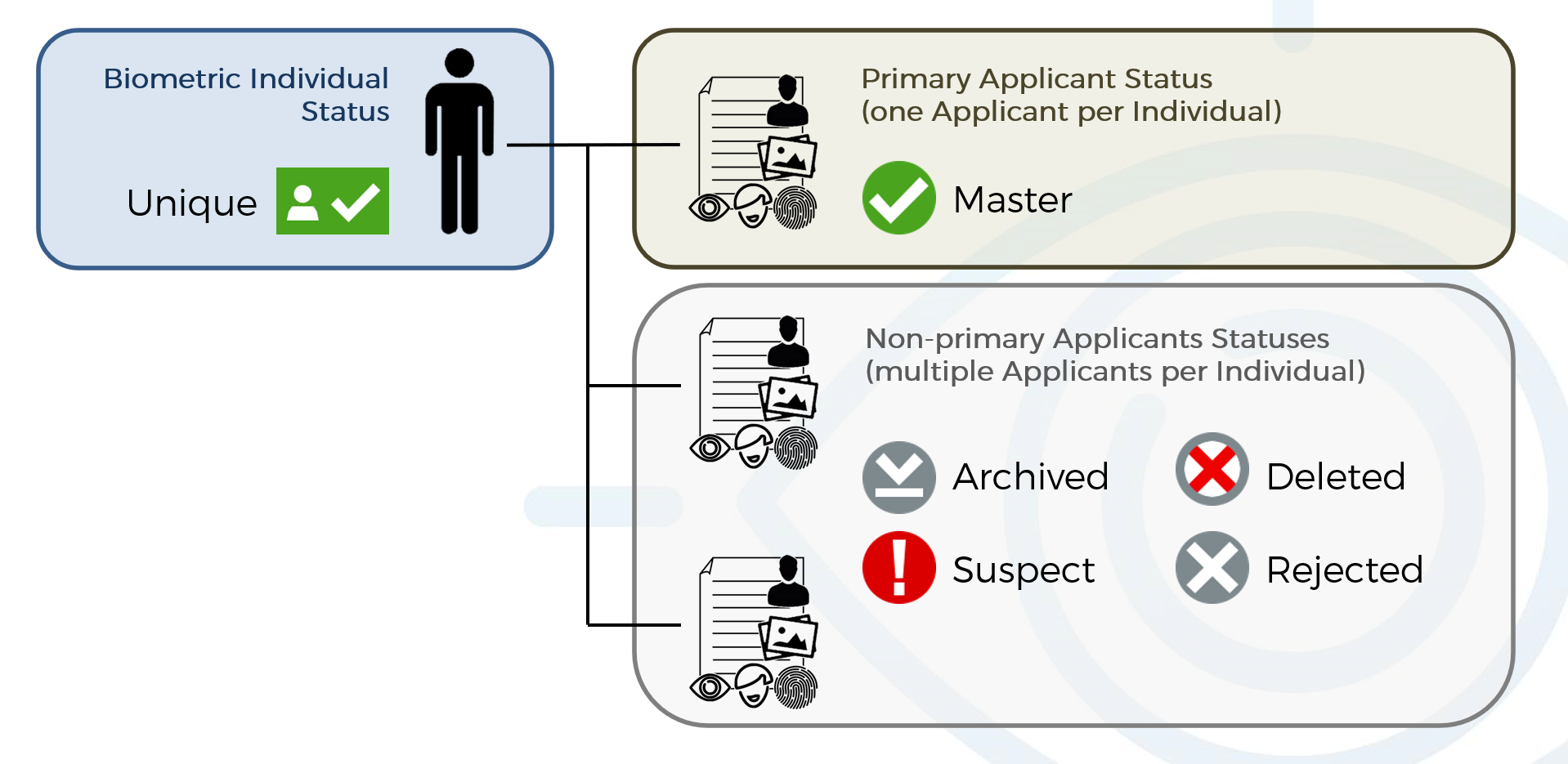
- Master – the record was determined to be unique. Achieved either after deduplication or by explicit master enrolment.
- Archived – the record was determined to be non-primary during hitlist resolution and was archived. Still identifiable.
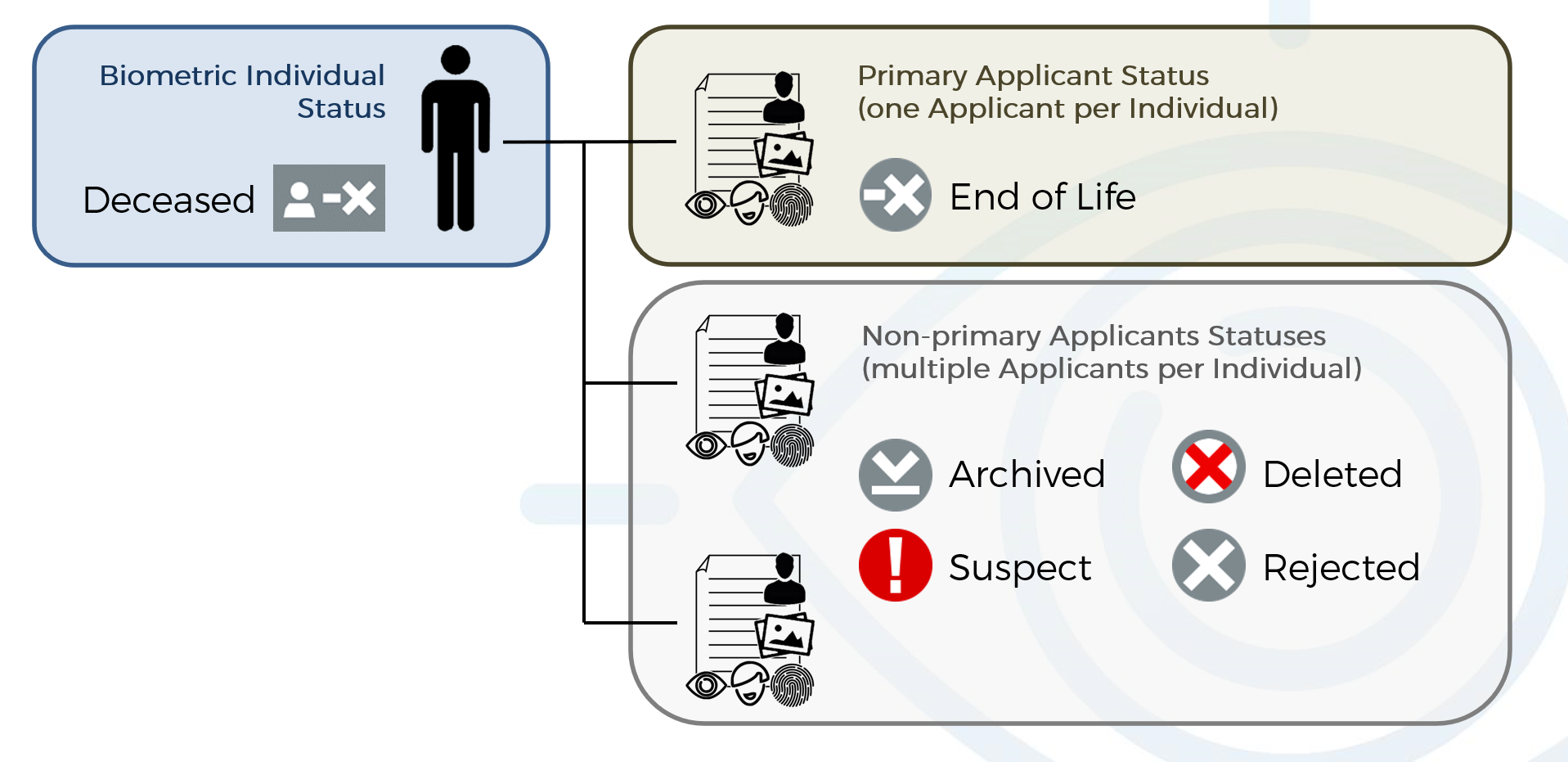
- End of life – the person has died (or the record is no longer valid). Still part of the matching engine to prevent fraud.
- Suspect – the record was determined to be non-primary during hitlist resolution and was marked as suspect. Differs from
Archivedonly semantically. - Incomplete – the record was determined to be unique but failed validation to become
Master.
Oblivion phase
Records that are on their way out of ABIS or are kept only for audit.
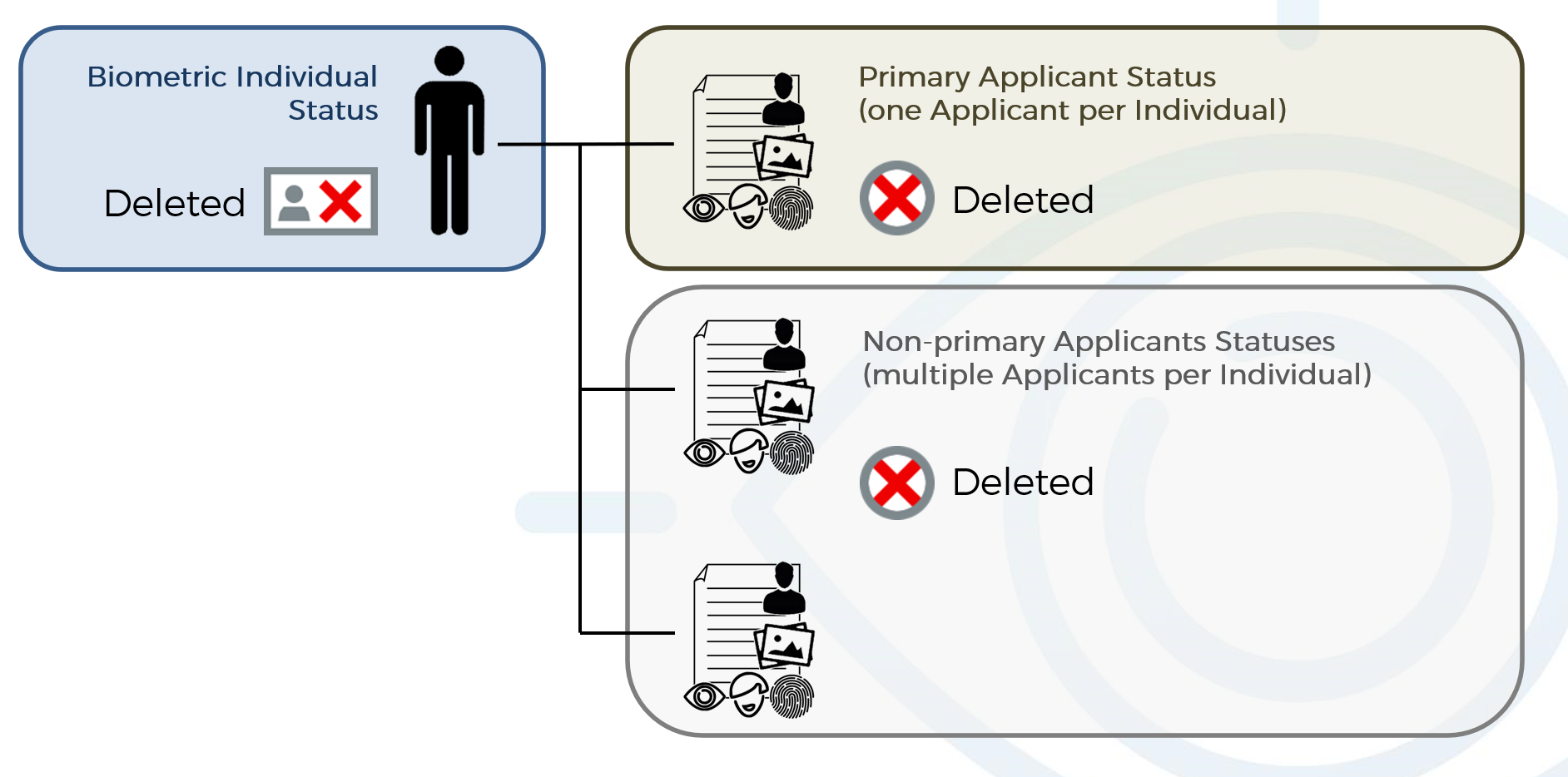
- Deleted – the record was deleted but still exists in ABIS for audit purposes.
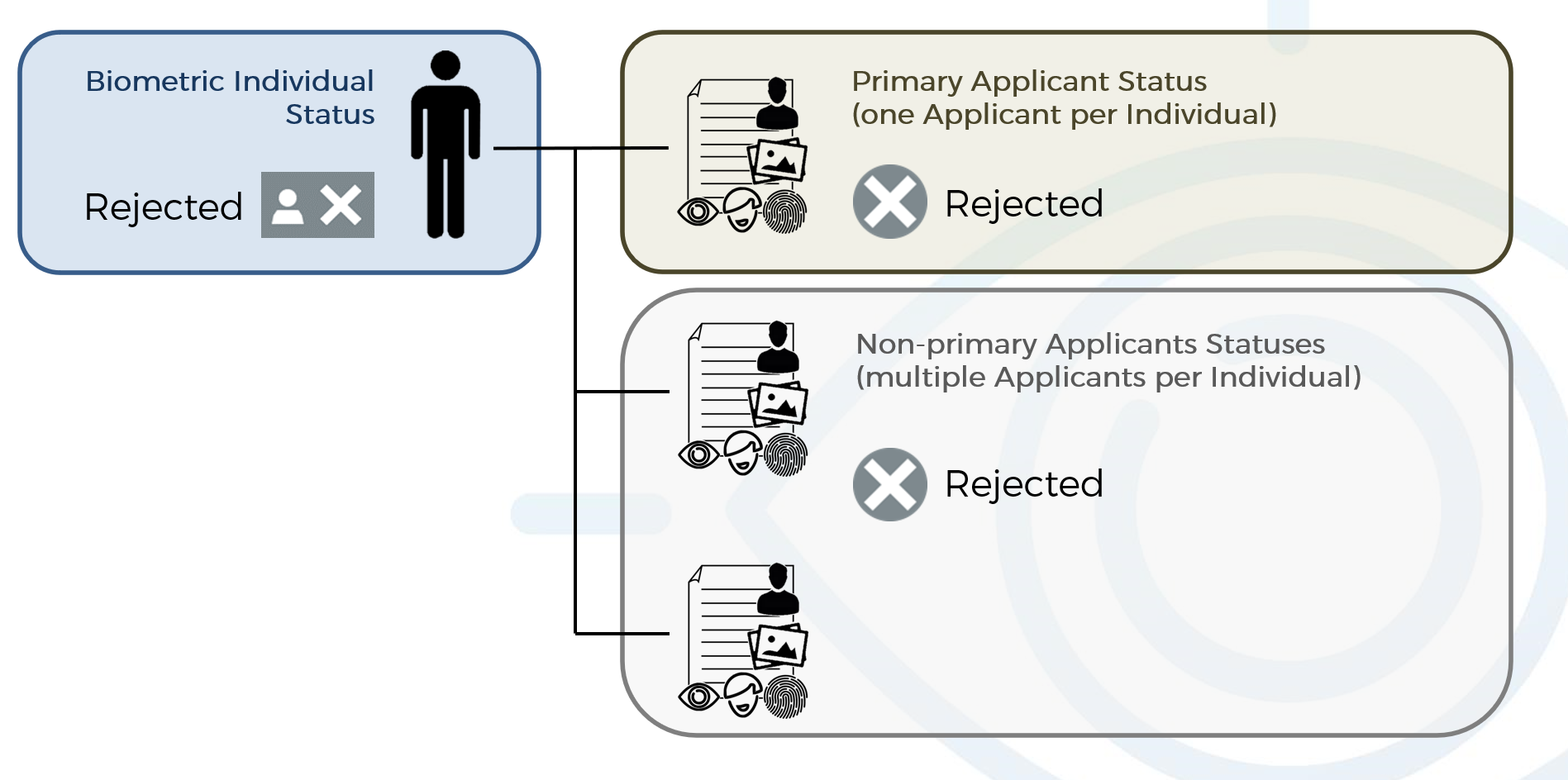
- Rejected – the record cannot be identified or verified. Differs from
Deletedonly semantically.
Biometric Individual
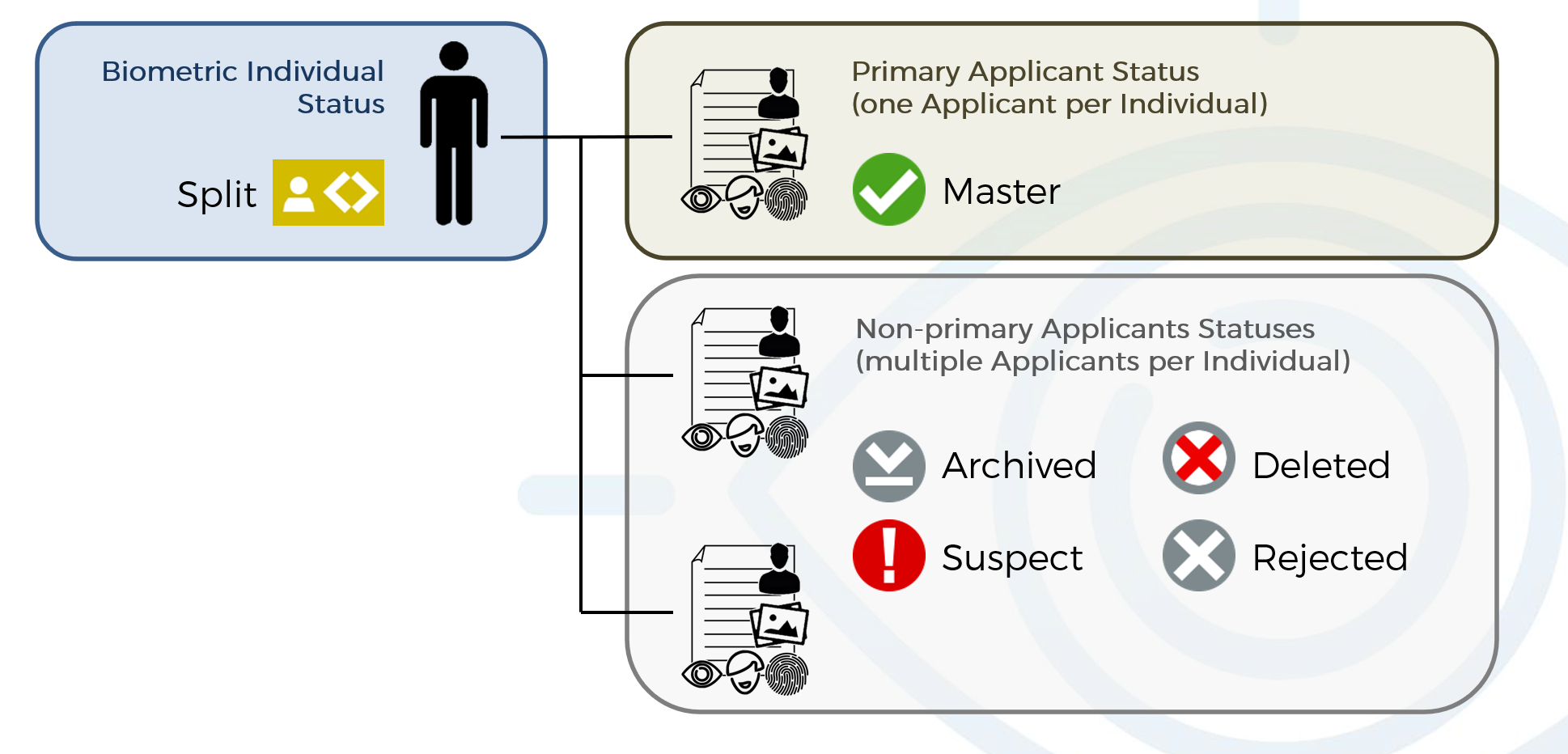
A Biometric Individual (BI) is an envelope that groups one or more applicant records that biometrically belong to the same person. Each valid BI has exactly one primary applicant representing the current state of the person.
The BI is what allows the agency to maintain a single consolidated criminal record of a person even when that person was booked many times over many years – every booking is a separate applicant, but the BI ties them all together.
The BI's state is reflected by its primary applicant. The diagrams below visualise the most common BI lifecycle scenarios:
Galleries
Records of known persons are organised into galleries. A typical Criminal Investigation deployment defines several disjunctive galleries, for example:
- Criminal applicants – persons with prior arrests.
- Wanted persons – active warrants.
- Persons of interest – non-arrest intelligence records.
- Case galleries – evidence collected from previous cases (see Cases and Evidence).
Every identification request can target one or more galleries. The matching threshold and accuracy parameters can be tuned per gallery.
Operations on criminal records
Criminal records expose the same set of CRUD operations as any ABIS applicant – create, read, update and delete. The detailed REST contract is documented in the Criminal records (Applicants) API chapter.
For deeper background on biometric matching itself please refer to Biometric matching.