ACE-V methodology
The ACE-V methodology – Analysis, Comparison, Evaluation and Verification – is the de-facto standard for forensic friction-ridge examinations and is also widely applied to face comparison. Innovatrics ABIS Criminal Investigation has full first-class support for ACE-V; the workflow is implemented around the examination entity introduced in Examinations and Hits.
The four phases
Analysis (A)
The examiner studies the unknown impression independently, without any reference to known prints. The goal is to assess the quality and quantity of the discernible ridge detail, considering:
- clarity, distortion and the substrate (the surface on which the print was left),
- level 1 detail – ridge-flow patterns (loops, whorls, arches),
- level 2 detail – minutiae (ridge endings, bifurcations),
- level 3 detail – poroscopy and edgeoscopy.
The examiner concludes whether the impression is of value / suitable for comparison or not.
Comparison (C)
If the impression is suitable, the examiner performs a side-by-side comparison with one or more known impressions. They look for agreement in type, location, orientation and relationship of the ridge characteristics, and consider whether any dissimilarities can be explained by pressure, distortion or deposition factors.
Evaluation (E)
The examiner forms a conclusion based on the data gathered in the previous two phases. The possible conclusions are:
- Identification (Individualization) – sufficient features in agreement to conclude that the two impressions originated from the same source.
- Exclusion – sufficient features in disagreement to conclude that the two impressions originated from different sources.
- Inconclusive – neither sufficient agreement to individualize nor sufficient disagreement to exclude.
Verification (V)
A second qualified examiner re-examines the work of the primary examiner. The purpose is to confirm or refute the primary conclusion and to ensure the objective application of the ACE process. The platform supports both blind and non-blind verification, configurable per deployment:
- In blind ACE-V, the verifying examiner does not see the primary examiner's conclusion. Both examiners work in parallel on their own examinations and the platform reconciles the two parallel results.
- In non-blind ACE-V, the verifying examiner reviews the primary work directly through dedicated Verification examinations attached to the Comparisons whose resolution requires verification.
For agencies that do not run ACE-V at all, the platform also supports a streamlined identification flow in which the verification step is omitted.
How the workflow looks in ABIS
The general flow supported by the system is:
- The investigator creates a case.
- A forensic technician uploads the evidence.
- The evidence goes through Technical Assessment at the evidence level. If it is judged unsuitable, no examinations are created.
- Once TA is passed, an Analysis examination is created and the examiner performs the Analysis phase inside the Latent Editor.
- From the identification result list, the examiner picks one or more candidates and creates Comparison examinations for them.
- Each Comparison is worked on inside the Comparison Tool and resolved with one of the configured ACE-V resolutions.
- Comparisons whose resolution requires verification trigger the verification step – through dedicated Verification examinations in non-blind ACE-V, or through the parallel Primary / Verification reconciliation in blind ACE-V.
- The investigator monitors the work and moves the evidence-level ACE-V status through TA → A → C/E → V → Processed as the underlying examinations progress.
The exact mapping of the Investigator, Forensic Technician, Examiner and Verification Examiner roles to people in the agency is configurable. The platform supports any combination – the same person can play several roles, or each role can be performed by a different person – with access rights enforced through the deployment's role and permission model.
Two distinct ACE-V status tracks
ABIS exposes two independent ACE-V status fields: one on the evidence and one on each examination. They have different roles and different sets of values, and the user advances them manually (the evidence-level field is not derived automatically from the examinations).
Evidence ACE-V status
The evidence-level ACE-V status is what the investigator uses to express the overall progress of the work performed on the evidence. It is the only place where Technical Assessment (TA) is tracked.
| Status | Abbreviation |
|---|---|
| Technical assessment | TA |
| Analysis | A |
| Comparison / Evaluation | C/E |
| Processed | – |
The status of an evidence is shown as an icon on the evidence thumbnail and in the header of the open evidence. It can be changed using the Change Status action available on the evidence detail page, and every change is recorded as an entry in the ACE-V status history. The investigator moves this status manually as the underlying examinations progress – it is not recomputed automatically.
If the evidence does not pass TA, no examinations are created.
Examination ACE-V status
The examination state machine is specific to the kind of the examination. Every kind has an in progress status (work has started) and a done status (the kind has been resolved and the result is recorded). The actual ACE-V outcome is captured by the resolution attached to the done status; the set of available resolutions is configurable per deployment.
| Examination kind | In-progress status | Done status |
|---|---|---|
| Analysis | Analysis in progress | Analysis done |
| Comparison | Comparison | Evaluation |
| Verification | Verification in progress | Verification done |
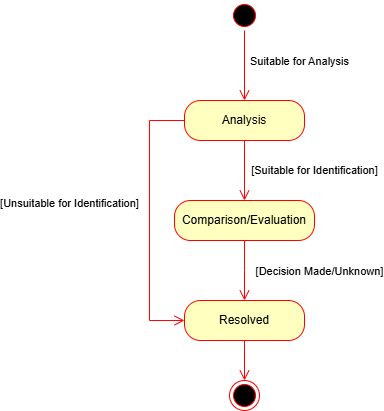
The examination state machine does not include TA – that step is recorded only at the evidence level. This separation, together with the parent / child examination tree (Analysis → Comparison → optional Verification), is what allows several examiners to work in parallel without influencing each other.
ACE-V and hits
The Evaluation phase of ACE-V translates into a hit with the appropriate relation type:
- Individualized → relation type
Individualized, - Excluded → relation type
Excluded, - Inconclusive → relation type
Inconclusive.
Multiple hits can be recorded per examination. Hits are visible in the examination sidebar, the evidence-level Hits table, and the case-level Hits table. Soft-deleted hits are excluded from hit counters.
Where to go next
- Look at how the platform implements the methodology in practice in the ACE-V Workflow module description.
- Inspect the API contract for examinations in the Examinations API chapter.