Biometrics glossary
Biometrics is the automated recognition of living persons from their biological or behavioural characteristics. Face Matcher works with one physiological modality, the face. Fingerprints, iris and DNA are other physiological modalities, and voice, handwriting and gait are behavioural ones; they follow the same capture, extraction and comparison model described here but are outside the scope of this product. The terms below appear throughout the documentation and in the API.
Capture and extraction
Biometric sample: the raw information from a capture device, for a face a 2D image of it.
Detection: locating a face in a frame and capturing it as a sample. In Face Matcher this is what the detector and the camera services do for every frame. Detection is affected by the environment: lighting, background, face size and pose.
Extraction: computing a set of distinguishing features from the sample. The result is the template.
Template: a compact numeric vector that represents the face for comparison. It cannot be turned back into an image and carries no identity data. Templates are bound to the extraction algorithm that produced them.
Enrollment: creating and storing a template for a person, in Face Matcher by registering a watchlist member from one or more images.
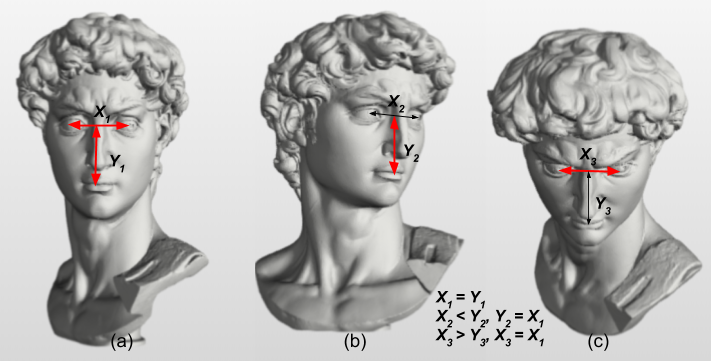
Face size: the larger of two pixel distances on the face, the distance between the eye centres and the distance between the mouth centre and the point between the eyes. Defined this way it stays stable when the head turns, tilts or rolls. Minimum face size settings in Face Matcher are expressed in these absolute pixels; the enrollment default is 30 px.
Comparison
Probe: the sample or template captured at the moment of comparison, for example a face seen by a camera or an image submitted to the API.
Reference: the template stored earlier, in Face Matcher the watchlist member's template. Better reference quality means a more accurate system.
Matching score: a number expressing the similarity of a probe and a reference template. Face Matcher scores range from 0 to 100; Station can additionally show a percentage derived from it.
Threshold: the score at which the system decides. Pairs scoring at or above the threshold are a match; pairs below it are a no match. The threshold is set per watchlist; see Accuracy and thresholds.
Verification (1:1): a person claims an identity and one probe is compared with one reference; the answer is accept or reject. Available through the REST API.
Identification (1:N): a probe is compared with some or all references in the database without a claimed identity; the answer is a list of candidates above the threshold. This is what watchlist matching and Station's identification page do. It costs more computation than verification because of the many comparisons.
Decision errors
False accept, FAR (False Accept Rate): a non-matching pair scores above the threshold, so an impostor is accepted. FAR is the fraction of impostor scores above the threshold; a low FAR is the priority wherever the goal is to keep the wrong people out.
False reject, FRR (False Reject Rate): a matching pair scores below the threshold, so a genuine person is not recognized. FRR is the fraction of genuine scores below the threshold and is mostly a convenience problem, often caused by poor-quality samples.
The two move against each other: the usual practice is to fix the acceptable FAR, measure the resulting FRR on your own data and then fine-tune the threshold. For identification the same idea is expressed as FPIR and FNIR (false positive and false negative identification rates).
Enrollment errors
Failure to detect (FTD): no face was found in the sample, because it is too small, badly lit or not visible.
Failure to capture (FTC): a face is there but the capture produced no usable sample, for example because of blur, occlusion or a camera too weak for the scene.
Failure to process (FTP): a sample was captured but no usable template could be extracted, or the quality check rejected it.
Failure to acquire (FTA): the combined rate of FTD, FTC and FTP. A high FTA reduces throughput and frustrates users; relaxing quality requirements (minimum face size, quality thresholds) lowers FTA but pushes noisier templates into comparison.
Failure to enroll (FTE): the proportion of people for whom no template could be stored at all. Relaxing quality rules lowers FTE at the cost of more comparison errors later; see Enrollment image quality for the settings that control this.